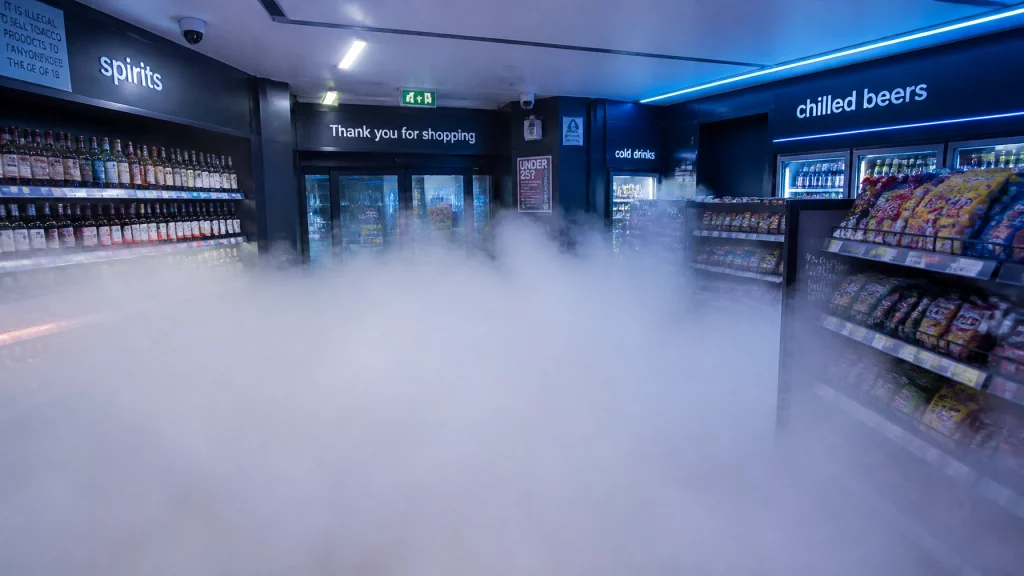
The best security fog system is the one that fills your specific space in seconds, works with the alarm you already have, and uses a food-grade, non-toxic fluid that leaves no residue. It should be certified to EN 50131-8:2019 — the European standard for security fog devices — and sized to the volume of the room it protects, measured in cubic metres. Get those four things right and an intruder is left in a dense white-out where they cannot see the stock, the till or the exit.
There is no single “best” unit for every building. A jeweller’s safe room and a 6,000 m³ distribution centre need very different machines. This guide sets out the criteria that separate a strong system from a weak one, then matches the Density® range to the type of premises you are protecting — so you can specify the right fog system in 2026 with confidence.
What makes a security fog system the best?
Seven things matter when you compare systems. Score any shortlist against these and the right choice usually becomes obvious.
1. Activation speed
Fog has to arrive before the intruder reaches the goods. A raid can be over in under a minute, so the system must deploy within seconds of the alarm triggering — not after a delay. Speed is the whole point of active fog: it turns a break-in into a wasted trip.
2. Coverage matched to volume
Security fog fills a space, so coverage is measured in cubic metres, not floor area — the fog protects everything up to the ceiling, including the space above high racking. A unit rated below your room’s volume will leave clear pockets an intruder can work in. Always size the machine to the m³ of the space, with headroom.
3. The right certification
Specify EN 50131-8:2019. It is the European standard written specifically for security fog devices, and it is what a serious insurer or risk manager will look for. Density systems also meet CE, EMC and FCC requirements, and an attestation of certification can be requested. If a lower premium is part of your case for buying, here’s how insurers actually view active security.
4. Food-grade, non-toxic fluid
The fluid is the part that touches your stock, your staff and the air they breathe. It should be certified non-toxic to people and animals, and safe around food. Density fluid is certified non-toxic by Eurofins and tested to the Food Contact regulation, Reg. (CE) No. 1935/2004 — so it can be installed in shops, bars, restaurants and food warehouses without altering the goods.
5. No residue
A good fog disperses cleanly and leaves nothing behind on clothing, electronics or packaging. That is the practical difference between fluid-based fog and older combustion “smoke”: you reopen and restock within minutes, with no film to wipe down and no damaged stock.
6. Alarm and camera integration
The system should connect to the alarm panel you already run, not force a rip-and-replace. Density units are compatible with all existing alarm panels and are fully compatible with Ajax, so fog can be triggered as part of a wireless setup. Cameras keep recording through the fog, capturing the intruder’s silhouette as evidence.
7. Remote monitoring and battery backup
Thieves cut the power. The best systems hold a battery backup so they still fire during a mains failure, and they log every event to your phone. Density’s ActiveCloud gives free remote monitoring, so a breach and fog release show up in real time wherever you are.
97% of thefts are avoided with a fogging system and an alarm, compared with 17% with an alarm only. This Density® manufacturer figure is the core reason fog is specified. An alarm warns; fog is the layer that turns that warning into a raid the intruder walks away from empty-handed.
The best security fog system for your type of premises
Match the machine to the job. The right unit follows from what you are protecting.
Protecting a single safe, ATM or till point? Where the target is one high-value point rather than a whole room, the best fit is the Density UNIK — a compact, cold-fog unit with no heat-up and zero heat emission that runs for up to six months on battery and covers up to 600 m³. It wins wherever there is a specific target to guard and no mains supply nearby.
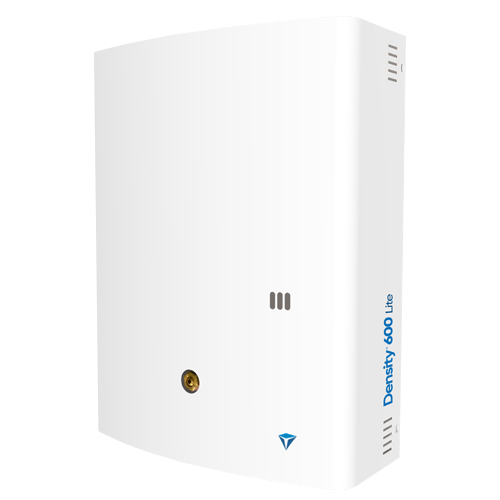
Small shops and back offices are well served by the Density 600C Line. It covers up to 600 m³ and fills in around 28 seconds, which suits most independent retail units, dispensaries and small stockrooms.
Step up to mid-size retail and hospitality and the Density 900 (900 m³) or 2400C Line (2,400 m³) take over, deploying in roughly 29 and 64 seconds to cover larger shop floors, bars and restaurants.
Warehouses and distribution centres are where volume coverage matters most, and where the HP Line earns its place. The HP6000 protects up to 6,000 m³ and the HP14000 up to 14,000 m³ — enough for high-bay racking and loading bays that a floor-area figure would badly understate. It is no coincidence that employee and organised theft cluster in exactly these buildings.
Cold and food storage is the case people assume rules fog out — and it does not. Because the fluid is food-contact certified, fog can be installed in chilled stores and food warehouses without tainting stock.
| Model | Coverage | Fill time | Best for |
|---|---|---|---|
| UNIK | up to 600 m³ | seconds (cold fog) | Safes, ATMs, single points; battery sites |
| 600C Line | 600 m³ | 28s | Small shops, dispensaries, back offices |
| 900 | 900 m³ | 29s | Safe rooms, small premises |
| 2400C Line | 2,400 m³ | 64s | Mid-size retail, bars, larger shop floors, restaurants |
| HP6000 | 6,000 m³ | 80s | Warehouses, distribution |
| HP14000 | 14,000 m³ | 200s | Large logistics, high-bay racking |
Get a Free Site-Specific Quote
Every building is different — a free site survey confirms the exact unit, coverage and install plan for your premises, no obligation.
Security fog or security smoke — which is better?
If you’ve searched for a “security smoke machine,” a “smoke generator security” system, or “security smoke systems” for your business, you’ve landed in the right place. They are often used to mean the same thing, but there is a real difference. Fluid-based security fog is dry, leaves no residue and is safe around electronics and food, which makes it the better fit for almost every commercial premises. Combustion “smoke” uses a cartridge that has to be replaced after each use and can leave visible dust.
One older drawback of fluid foggers was the heating element they kept hot around the clock to stay ready. Density’s UNIK removes that entirely: it is a cold-fog generator with no heat-up and two international patents, so it is ready instantly and runs on battery alone.
Is security fog safe? What the fluid is made of
Security fog is made from a mix of food-grade glycol and water — the same family of non-toxic glycols used in food and cosmetics, not the toxic ethylene glycol found in antifreeze. It is certified non-toxic by Eurofins and evaluated to EN ISO 16000-1:2006. People and animals can breathe it without harm; the effect is loss of vision, not loss of health.
What is new for security fog in 2026
The clear direction of travel is smart, connected protection. The fastest-growing part of the market is IoT-enabled fogging with remote monitoring and tighter alarm integration, and 2026 has seen a wave of “Ajax-ready” launches across the industry. Density already sits in this space: ActiveCloud delivers free cloud monitoring and the units are fully Ajax-compatible, so a modern wireless alarm and the fog layer act as one system.
The backdrop is a hard year for UK businesses. The British Retail Consortium puts retail theft at around £2.2 billion a year, retail-crime incidents in England and Wales have pushed past half a million, and the 2026 ACS Crime Report describes an 11p “crime tax” on every shop transaction. Cameras record the loss; fog is what prevents it. For a hands-on assessment, see our honest test of whether anti-burglary fog actually works.
Frequently asked questions
Is security fog safe for people and animals?
Yes. The fluid is certified non-toxic by Eurofins and evaluated to EN ISO 16000-1:2006. It is a food-grade glycol and water mix — not the toxic glycol in antifreeze. It blocks vision without harming anyone in the room.
Will security fog set off the fire alarm?
It should not, when installed properly. Security fog is a fine, water-based fog, not combustion smoke, and a competent installer will interface it with your fire system so the two do not conflict — the fog can be configured to stand down if a fire alarm activates. Always confirm the setup with your installer. See the full breakdown of detector types and why this happens.
Does security fog damage stock, electronics or food?
No. The fog is dry, leaves no residue and is certified to the Food Contact regulation, Reg. (CE) No. 1935/2004. It does not stain fabric, mark electronics or taint food, so you can restock within minutes of an incident.
How quickly does security fog fill a room?
Within seconds of the alarm triggering. Fill time depends on the unit and the volume — for example, the 600C Line reaches full density in about 28 seconds and the HP6000 covers 6,000 m³ in around 80 seconds.
Is security fog approved to a UK standard?
Look for EN 50131-8:2019, the European standard for security fog devices. Density systems meet it along with CE, EMC and FCC requirements, and an attestation of certification can be requested for insurers. That’s separate from NSI/SSAIB approval, which covers installer companies rather than the device itself — here’s how the two fit together.
How much does the best security fog system cost?
It depends on the volume of the space, the number of entry points and how the unit integrates with your alarm — a single-point unit and a multi-zone warehouse install are very different jobs. The reliable way to get an accurate figure is a free site survey, where the space is measured and the right unit specified. Book one and you get a quote built for your building, not a guess. See exactly what drives the price before you do.
The best security fog system, in the end, is the one specified to your building rather than bought off a shelf. Match coverage to your volume, insist on EN 50131-8:2019 and food-grade fluid, and make sure it fires in seconds on the alarm you already run. To see exactly which unit fits your site, read how security fog works, browse the full Density range, or book a free site survey and we will size it and quote it for you.
Get a Free Site-Specific Quote
Tell us about your premises and we’ll recommend the right Density system — no obligation, no sales pressure, just the right solution sized to your building.