UK retail theft costs £2.2 billion a year. Over 20 million theft incidents happen annually—more than 55,000 per day. Single defences fail. A camera alone does not stop theft in the moment. An alarm alone cannot respond fast enough. Shops that cut their losses use layered strategies. Each layer stops a different stage of the theft. Layer one: before the thief acts. Layer two: during the break-in. Layer three: active defence. This post explains how these layers work together and why combining them beats any single system.
Layered defence is the only proven approach. It builds redundancy. If one layer fails, others stay active.
Layer 1: Visible Deterrence
The first layer begins before theft happens. A thief assesses risk before attempting a heist. If security is visibly strong—professional signage, obvious CCTV, uniformed staff—many potential offenders simply move to an easier target.
Visible systems include:
- Professional anti-theft signage placed prominently at entrances and key zones
- Visible CCTV cameras positioned to cover entry points and high-value areas
- Well-lit store design with minimal blind spots, so staff sightlines are clear
- Security staff presence or obvious panic buttons
Visibility removes anonymity. A thief who knows staff can see them is far less likely to act. This layer discourages opportunistic theft.
Layer 2: Detection and Alarm
For organised criminals, visible security alone is not enough. They study routines, identify gaps, and time attacks. The second layer catches what the first doesn’t deter: electronic detection.
Alarms sense what humans miss:
- Forced-entry sensors on doors and windows trigger instantly
- Motion detectors in secure zones alert staff to movement where none should be
- Electronic article surveillance (EAS) tags on high-value stock alert at exit points
- Access-control systems log who enters restricted areas and when
Speed is critical. The faster the alarm activates, the faster your response begins. A break-in detected in the first seconds gives you a narrow window to intervene. But detection alone is not intervention.
Layer 3: Active Response—The Fog System
Detection triggers an alarm. But there is a dangerous delay between alarm and physical response. Police take time to arrive. Staff must react. Thieves exploit that gap.
Active fog fills it instantly.
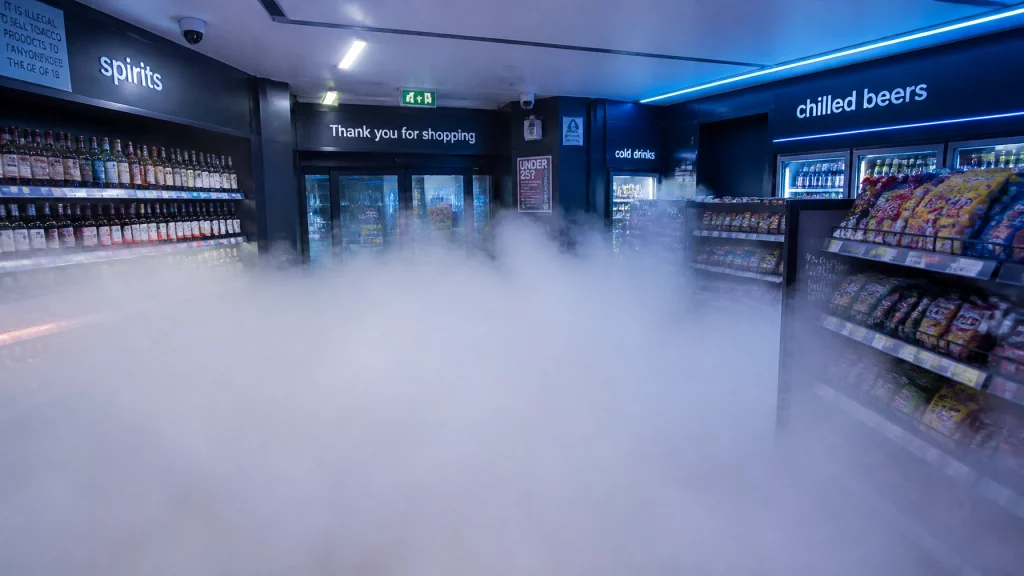
When the alarm sounds, fog deploys instantly. Visibility drops to near-zero within seconds. Thieves cannot identify stock. They cannot load goods. They cannot escape. The theft plan fails.
97% of thefts are avoided with a fogging system AND an alarm, compared with 17% with an alarm only. Density® manufacturer figure.
Fog works because it is unpredictable. Organised gangs study cameras and staff patterns. They can bypass alarms. They cannot function in zero visibility. Fog acts instantly. Police take time to arrive.
Coverage must be complete. Any unprotected corner becomes an escape route. For small shops, a Density 900 generator covers up to 900 m³. For larger premises, the HP Line systems cover up to 14,000 m³.
Layer 4: Integration and Monitoring
Individual layers are strong. Integrated layers are stronger.
Modern security systems must talk to each other. Your CCTV, alarm panel, and fog system should activate as one coordinated response, not separate devices. Integration means:
- The alarm triggers the fog automatically—no manual step, no delay
- CCTV records the incident alongside the alarm timestamp for later review
- Remote monitoring lets your security team track events from anywhere via systems like ActiveCloud
- Integration with existing alarm infrastructure ensures compatibility with Ajax and all major panels
Without integration, layers work alone. Fog systems connect to all alarm panels, CCTV systems, and video platforms via LAN and APIs. Integrated layers respond in seconds.
Why Layers Beat Any Single Solution
A shop defended by cameras alone loses money. Thieves know cameras record but do not stop them in the moment.
A shop defended by alarms alone still loses £350,000 per 100 incidents (based on the 17% figure above: 83% of thefts succeed with alarm-only protection).
A shop with all four layers—visible deterrence, detection, active response, and integration—has moved the odds decisively in its favour. Organised gangs target easy opportunities. A fully layered site is not one.
The National Retail Federation and retailers across Europe have adopted this multi-layered model as standard. UK loss-prevention specialists now recommend it universally for any site with high-value stock or 24-hour operation.
Building Your Layered Strategy
Start with an audit. Walk your space and identify where each layer exists and where it is weak.
Layer 1: Is signage professional and visible? Do sightlines cover your highest-risk zones? Are there blind spots behind racking or in corners?
Layer 2: Are your sensors covering entry points and secure stock areas? Is your alarm monitored 24/7? Do EAS tags cover your most valuable items?
Layer 3: Do you have active defence in place? A fog system adds a response layer that neither cameras nor alarms provide alone.
Layer 4: Are your systems integrated, or do they operate independently? Can your alarm trigger your fog automatically? Does your CCTV sync with detection events?
Audit findings will reveal which layers are weak and need investment. For the wider picture, see our retailer’s guide to loss prevention. Loss-prevention specialists can conduct a professional survey to confirm whether your site meets current best practice.
Frequently asked questions
Why is a single security measure not enough?
Thieves adapt. Organised crime gangs study each layer separately and find ways around it. Visible CCTV can be avoided by hiding faces. Alarms can be triggered by accident, desensitising staff. No single layer stops a determined, coordinated attack. Layering forces attackers to overcome multiple obstacles simultaneously—at which point the effort and risk become too high and they move elsewhere.
How long does a fog system take to deploy?
Fog deploys within 1–2 seconds of alarm activation. Full coverage of most premises takes 60–90 seconds. By that time, thieves face total visual loss and cannot proceed with a coordinated heist.
Will fog damage our stock or harm staff?
The fog is non-toxic and certified by Eurofins to standards including EN ISO 16000-1:2006. It is food-safe (certified to Reg. CE No. 1935/2004), leaves no residue, and does not stain merchandise or equipment. Staff and customers are safe. Cleanup is quick and operations resume immediately.
Can we integrate fog with our existing alarm and CCTV?
Yes. Density fog systems work with all alarm panels, CCTV systems, and video management platforms via LAN and APIs. Integration happens at setup and requires no replacement of existing infrastructure.
How do we know if our layered strategy is working?
After installation, monitor incident rates and cost of goods lost. Retailers typically see a 70–90% reduction in theft incidents within the first year of implementing a full layered system with fog. CCTV footage and alarm logs provide auditable proof of improvement.
Securing Your Shop Today
Single-layer security has failed the UK retail sector. With theft incidents reaching 20 million annually and total retail crime costs exceeding £4 billion, retailers can no longer afford piecemeal defence.
A layered strategy is not optional complexity—it is the proven standard. If your shop faces theft risk—and most UK retail sites do—your security should include visible deterrence, electronic detection, active response, and integrated monitoring.
If you are unsure whether your current setup covers all four layers, get a professional security survey. A no-obligation assessment will identify gaps and confirm whether your site is truly defended. Contact us to book a loss-prevention audit.