Bike shops face a theft problem. High-value bikes are packed into small spaces. Staff numbers are often tight. Hours are limited. A single smash-and-grab costs thousands. This guide shows you the security layers that work for cycle shops, from alarms to rapid fog deployment.
The answer isn’t one single solution. It’s layering.
Why bike shops attract theft
Bicycles are portable and valuable. There is steady demand for them on resale websites. Thieves target bike shops because stock is easy to see and concentrated in one place. It’s usually only protected when the shop is open. Closed shops are especially at risk. Thieves know they have minutes before police arrive, and stockroom locks are often easy to break.
High-end models—carbon frames, electronic groupsets, premium wheels—are the primary target. But thieves also take components, tools, and accessories, which compound the loss across multiple customers’ orders and your own stock.
The three-layer security stack
Effective bike shop security combines three elements: detection, deterrence, and response.
- Detection: Alarm systems (audible and remote alerts) + CCTV (recorded evidence and live monitoring).
- Deterrence: Visible signage, exterior lighting, and the rapid deployment of security fog.
- Response: Speed. The faster you deny a thief access or visibility, the higher the likelihood they abandon the attempt.
A study by Density, the manufacturer of fogging systems sold in over 80 countries, found that 97% of thefts are avoided with a fogging system AND an alarm, compared with 17% with an alarm only. The difference is decisive.
97% of thefts are avoided with a fogging system AND an alarm, compared with 17% with an alarm only. — Density manufacturer figure
Alarms as the first line
A monitored alarm panel (wired or wireless) triggers on entry and alerts a monitoring centre. Response time varies—typically 10 to 30 minutes for police dispatch—but the noise and police notification alone stop many break-ins before items leave the building.
Modern alarm panels work with your CCTV, access logs, and mobile apps. If you have an alarm already, a fogging system will work with it. No replacement needed. Fog systems work with all standard alarm types.
CCTV: Evidence and live watch
Recorded footage helps with insurance claims and police work. Live monitoring lets you or a security team watch the shop outside opening hours. This is most useful for stockrooms and street-facing bike racks.
Cameras alone rarely stop a determined thief, but they become powerful when combined with fog. A thief who sees cameras but no fog might still try; a thief who sees fog deploy knows they’ve lost visibility and the shop’s occupants have been alerted.
Security fog: The active layer
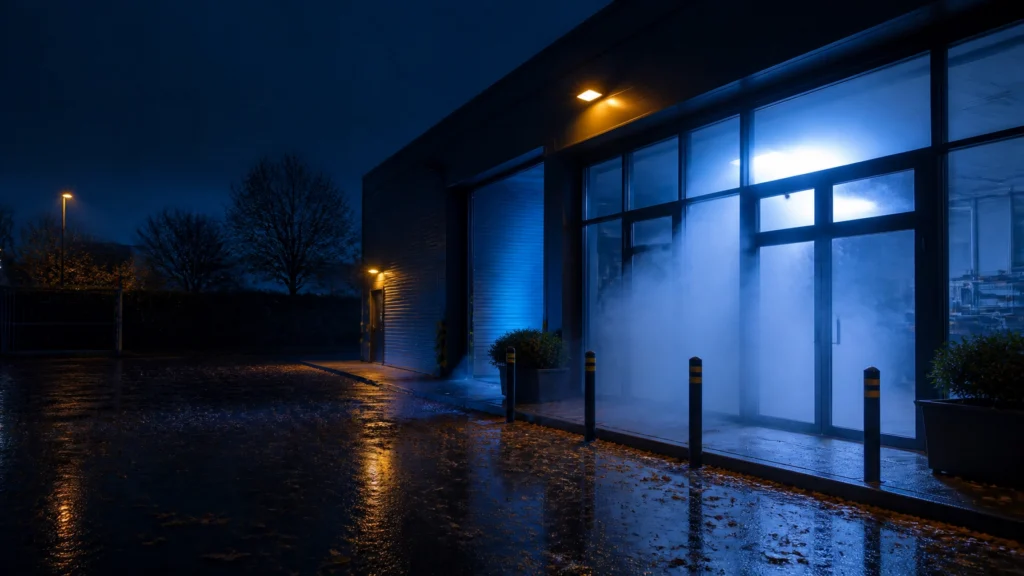
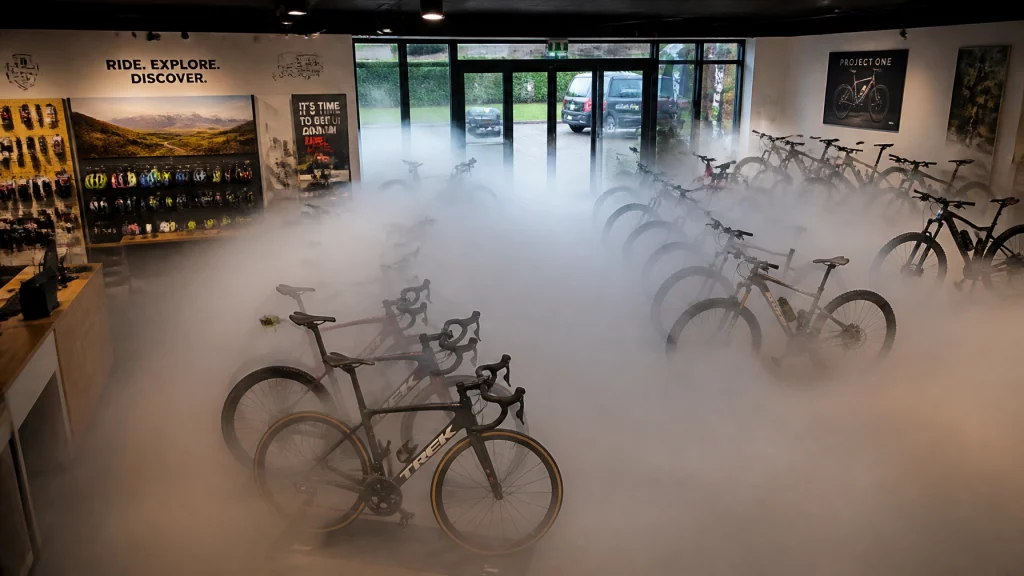
When an alarm triggers, the fogging system fills the shop with a thick, non-toxic mist. Within seconds, you can’t see more than a few inches. The thief loses their way, abandons the theft, and runs. Or they stay and wait for police.
The fog meets food-contact safety standards (Reg. (CE) No. 1935/2004) and the alarm system standard EN 50131-8:2019. It leaves no residue. It is non-toxic to humans and animals (certified by Eurofins).
For a bike shop, a compact system like the UNIK fog system often works well. It makes fog instantly. It runs on battery for up to six months. No heat or power cables are needed. It covers up to 600 cubic metres—enough for most retail shops and stockrooms together.
Protecting the stockroom and workshop
High-value frames and components in the stockroom should have a separate fog trigger from the retail floor. A panic button in the workshop lets staff turn on fog manually if they see a break-in during trading hours.
Separate circuits mean thieves can’t trigger the retail fog to hide their move to the stockroom. The stockroom is much harder to rob.
Integration and monitoring
Modern fog systems link to your alarm and ActiveCloud remote monitoring. You get alerts on your phone. You can watch CCTV from anywhere. If a break-in happens while you’re closed, fog deploys, police are notified, and you get a real-time alert.
For cycle shops with multiple branches, you manage all sites from one dashboard.
Site-specific considerations
A corner shop on a busy street has high visibility, which helps. But you’re a target because you’re easy to reach. Ground-floor stockroom? Fog is your fastest and most reliable defence.
Basement storage? Fog works well in confined spaces. It actually performs better when air circulation is limited.
The complete approach for bike retailers
A typical security setup combines:
- 24/7 monitored alarm panel with entry sensors on all doors and windows.
- CCTV covering the till point, retail floor, and external bike racks.
- Security fog linked to the alarm, with activation also available by panic button.
- Reinforced storage for high-value stock during closed hours.
- Clear external signage indicating alarm and fog systems.
This approach stops entry, detects attempts, responds fast, and gathers proof. It works because each layer tackles a different part of the thief’s thinking: risk, effort, and escape time.
Related Bike Shops security guides
- Protecting High-Value Bikes After Closing — Learn how to safeguard premium inventory when the shop is closed and risk is highest.
- Why Bike Shops Are a Smash-and-Grab Target — Understand the theft tactics that put cycle retailers in the crosshairs.
- Securing the Stockroom and Workshop — Separate protection for your back-of-house inventory and repair area.
- Choosing Security Layers for a Cycle Retailer — A decision framework for selecting the right combination of systems for your space.
- How Security Fog Protects a Bike Shop in Seconds — See how fog deployment works in practice and why response speed matters.
- Bike Shops sector — Browse all security resources for cycle retailers.
Frequently asked questions
Will security fog damage bikes or components?
No. The fog is non-toxic and leaves no residue. It’s certified to food-contact safety standards. It poses no risk to bikes, frames, or stock. Once the alarm is cleared, the fog clears naturally within minutes. No trace is left.
Can I integrate a fogging system with an existing alarm?
Yes. Fog systems work with all standard alarm panels, including wireless types. No replacement needed. The fog triggers from your existing alarm. Your alarm installer can handle the setup.
How often does fog need to be refilled?
It depends on the system and testing. Most systems last 5–10 years between refills. Many retailers test once a year to check the system works. This uses a small amount of fluid. Your service provider will advise based on your local rules.
Is a fogging system required by my insurer?
Check your policy. Many insurers reduce premiums if you have an alarm. Some also recommend or require fog, especially for high-value stock. Talk to your broker before buying. They may have preferred suppliers or rules.
What happens if someone triggers the fog accidentally?
Most systems have a manual override and a grace period (usually 30 seconds to 2 minutes) before fog deploys. Staff can turn off the alarm if it’s a false trigger. Some retailers add a panic button in the office (away from the retail floor). Staff activate fog only if they confirm a real break-in.
Ready to secure your bike shop? Request a site survey and security quote from Density. We’ll assess your space, recommend the right system, and guide you through installation and staff training.