The checkout aisle catches the eye. But the real theft happens behind the swing doors. Supermarket stockrooms hold the highest-value, most concentrated inventory in the building—concentrated, moveable, and easier to monitor than the sales floor. Yet they remain one of the least protected areas most retailers tackle.
This is the gap that costs supermarkets money. In 2024/25, UK retail lost £2.2 billion to theft across 20 million reported incidents. A significant portion of that—40% of all shrinkage—is employee or internal theft, and stockrooms are where that vulnerability is sharpest.
Why Stockrooms Are Theft Hotspots
A stockroom is a thief’s opportunity. High-value goods sit in bulk, organised for efficiency, not security. Staff move in and out constantly. Deliveries arrive at unsupervised moments. CCTV coverage is often focused on the shop floor, not the back. And once goods disappear into a stockroom, they can leave the building through loading bays or staff exits with little friction.
The profile of stockroom theft is distinct from shoplifting on the sales floor. It is less spontaneous, more calculated. It includes:
- Employee collusion—staff working with external accomplices to move high-value lines.
- Opportunity theft—staff taking items during quiet periods or using admin gaps to move stock off books.
- Organised gangs targeting specific high-value products (alcohol, beauty, branded lines) during deliveries or shift changes.
- Damage to goods claimed as loss, then removed and resold.
Once an intruder or dishonest staff member is in the stockroom, they have time and privacy to select, pack, and exit. Traditional cameras deter but do not stop determined theft. By the time CCTV footage is reviewed, the goods are gone.
The Security Gaps in Stockroom Design
Most stockrooms are protected only by closed-circuit television and access logs. These are reactive. A thief seen on camera has already committed the crime. The damage is done.
Alarm systems help, but they rely on perimeter intrusion—door and window sensors. They do not defend the space itself. Once someone is inside, the alarm has already failed its primary function.
97% of thefts are avoided with a fogging system and an alarm, compared with 17% with an alarm only. This is a Density® manufacturer figure—the difference between passive detection and active deterrence.
The key difference is active presence. A thief entering a stockroom prepared with a fogging system does not get time to select, pack, and leave. They cannot see. They cannot work. The system activates in seconds.
How Fog Deters Stockroom Theft
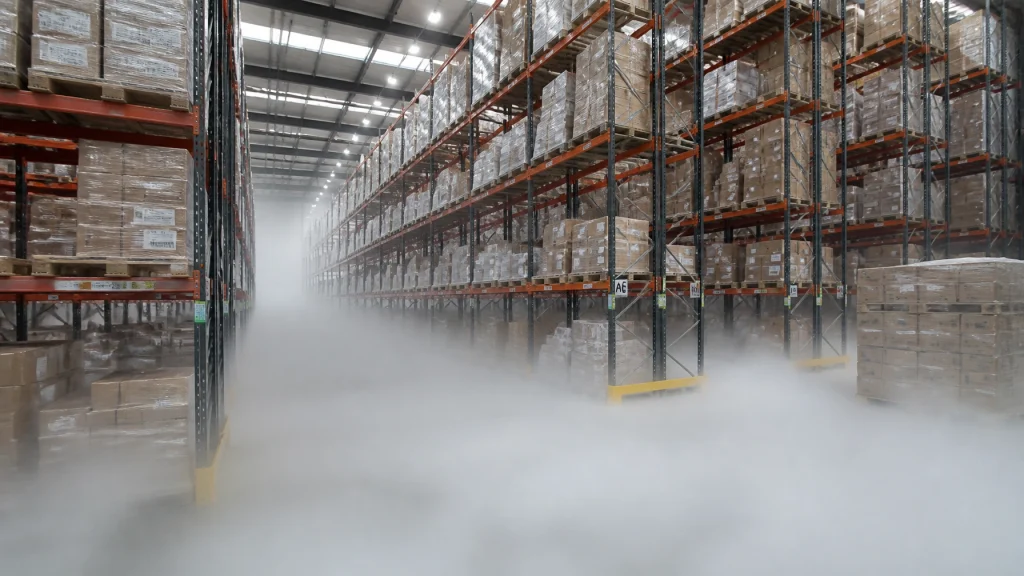
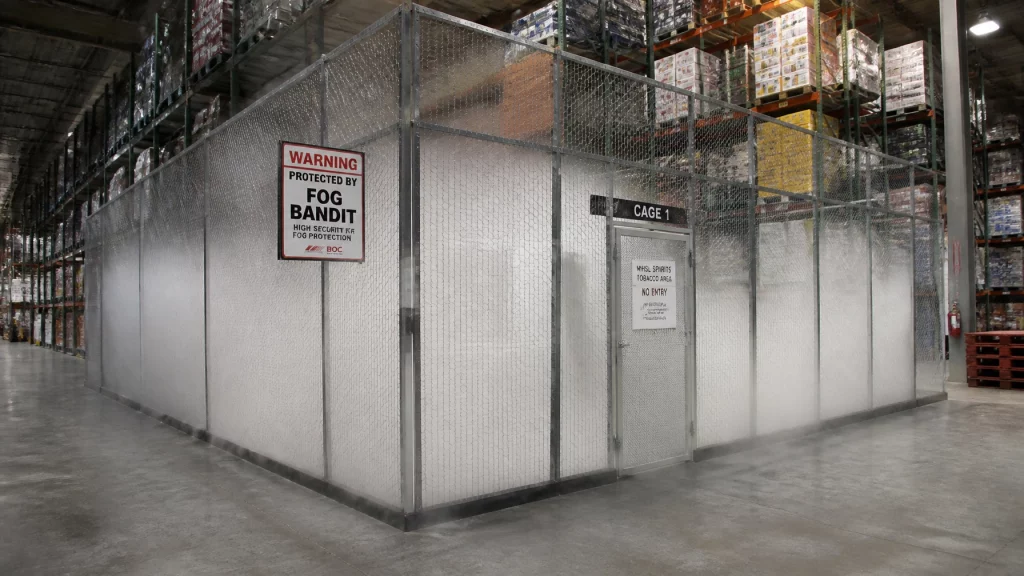
Security fog works by doing one simple thing: it removes visibility. The moment an unauthorised entry is detected—door breach, motion sensor, or manual trigger—the system deploys a dense, harmless fog that fills the stockroom within seconds. A thief cannot see their own hands. They cannot identify valuable stock. They cannot work.
The psychology is immediate. A would-be thief stepping into a fog-filled room has seconds to decide whether to stay. The risk becomes obvious. Most abandon the attempt.
For an internal attacker—an employee who knows the stockroom layout—fog is equally effective. The layout does not matter if they cannot see. The psychological barrier is reinforced by the certainty that fogging systems are connected to alarms and monitoring. Activation is evidence. Escape is harder.
Density systems are designed for commercial environments. The fog itself is non-toxic, certified by Eurofins for safety around humans and animals, and tested to food-contact standards (Reg. (CE) No. 1935/2004). This matters in supermarkets: the fog will not contaminate stock, harm customers if they are nearby during accidental activation, or leave sticky residue on shelves or products.
Installation and Integration
A stockroom fog system integrates seamlessly with your existing security setup. It works with any alarm panel—no replacement of current infrastructure needed. The system is fully compatible with Ajax alarm systems and supports free remote monitoring via ActiveCloud, so you can see activation events in real time from anywhere.
The Density HP line covers large volumes: the HP6000 protects up to 6,000 cubic metres, and the HP14000 up to 14,000 cubic metres. For typical supermarket stockrooms (ranging from 200 to 1,200 cubic metres), a single unit delivers complete coverage.
The system meets the security standard EN 50131-8:2019 and achieves CE and EMC compliance, giving you the assurance that your security layer is tested, certified, and fit for purpose.
Stockroom Fog as Part of a Wider Strategy
Fog does not replace CCTV, access control, or staff training. It complements them. Protecting stockrooms and high-value aisles requires layers: monitoring, deterrence, access discipline, and active defence. Fog is the active layer.
When combined with an alarm (as the 97% figure emphasises), fog becomes a genuine barrier. The thief sees the fog, hears the alarm, and knows they are caught on camera. The decision to flee is rational. Shrinkage in that stockroom drops.
Retailers report measurable reductions in back-of-store loss after installing fog systems. The effect extends beyond theft prevention: staff behaviour changes when they know the stockroom is truly protected. Opportunity theft becomes unthinkable. Collusion becomes riskier.
Why Supermarkets Choose Fog for Stockrooms
Supermarkets operate on thin margins. A 1% reduction in shrinkage can move a store from break-even to profit. Stockroom theft is concentrated loss—high value in one area. Protecting that area with a system that stops theft (not just records it) is cost-effective security.
Learn more about security fog for supermarkets and how the technology is deployed across the retail sector. For details on the HP range and its coverage capabilities, explore the Density HP system.
Frequently asked questions
Will fog damage stock in the stockroom?
No. Density fog is non-toxic, certified by Eurofins, and tested to food-contact standards. It will not contaminate, stain, or mark products. It dissipates within minutes of system deactivation, leaving no residue.
How quickly does the fog deploy?
Density systems fill a typical supermarket stockroom in seconds. The speed of deployment is part of the deterrent effect—a thief has no time to act.
Can I integrate fog with my existing alarm panel?
Yes. Density fog systems are compatible with all existing alarm panels. No replacement of current infrastructure is needed. The system can also integrate with Ajax and supports free remote monitoring via ActiveCloud.
What coverage do I need for a supermarket stockroom?
Coverage is measured in cubic metres, not floor area. A typical supermarket stockroom is 200–1,200 m³. The Density HP range covers up to 6,000 m³ (HP6000) or 14,000 m³ (HP14000). A site survey will confirm the right model for your space.
How is the system monitored?
Fog activation triggers your alarm system and sends a real-time alert to your monitoring centre and mobile devices via ActiveCloud. You can see exactly when and where the system deployed.
Securing a supermarket stockroom means stopping theft, not just recording it. Security fog, combined with your alarm system, transforms a vulnerable space into one where theft is not viable. If you are ready to reduce back-of-store shrinkage and protect your highest-value inventory, get a survey and quote from our team. Contact Density Security Fog today to discuss your stockroom protection plan.