Break-ins happen when shops are closed. That’s when premises are most vulnerable—security reduced, staff absent, response times slow. For retailers, this window between closing the doors and opening again the next morning represents a genuine gap in your loss-prevention strategy.
Most burglaries occur during evening and night hours. Police response to retail incidents is often poor, with 61% of retailers describing police attendance as inadequate. Closing time is when professional thieves strike.
The Closed-Premises Risk Profile
When a retail premises shuts down for the day, the risk profile shifts. Your staff have gone. Your CCTV is recording, not deterring. Your alarm is armed—but an alarm alone does not stop a thief who has already cut through the security shutters or forced a back door.
Closed-time theft follows a pattern. Offenders scout locations beforehand. They know when the premises empty. They watch for gaps between final lock-up and the first morning checks. A smashed window. A crowbar on a till. Stock removed quickly through a rear exit. The entire operation takes minutes.
By the time police arrive, the damage is done.
Why Alarms Are Insufficient
An alarm does one thing well: it alerts. It signals to a central station, dispatches monitoring, and may summon police.
But an alarm cannot protect stock whilst it sits on the shelves during the hours between close and open. An alarm cannot prevent a thief from spending fifteen minutes inside your premises, filling bags, and leaving before police arrival. An alarm cannot stop the break-in itself—only announce it after the fact.
Response times matter. In urban areas, police may attend within 20–30 minutes of an alarm trigger. In quieter retail locations or peak incident periods, response can exceed an hour. That interval is the thief’s window of opportunity.
A fogging system combined with an alarm prevents 97% of thefts. An alarm alone prevents just 17% (Density® manufacturer figure). The difference is active prevention versus passive detection.
97% of thefts are avoided with a fogging system AND an alarm, compared with 17% with an alarm only. Density® manufacturer figure. Fog plus alarm creates active defence, not just passive monitoring.
How Fogging Bridges the Response Gap
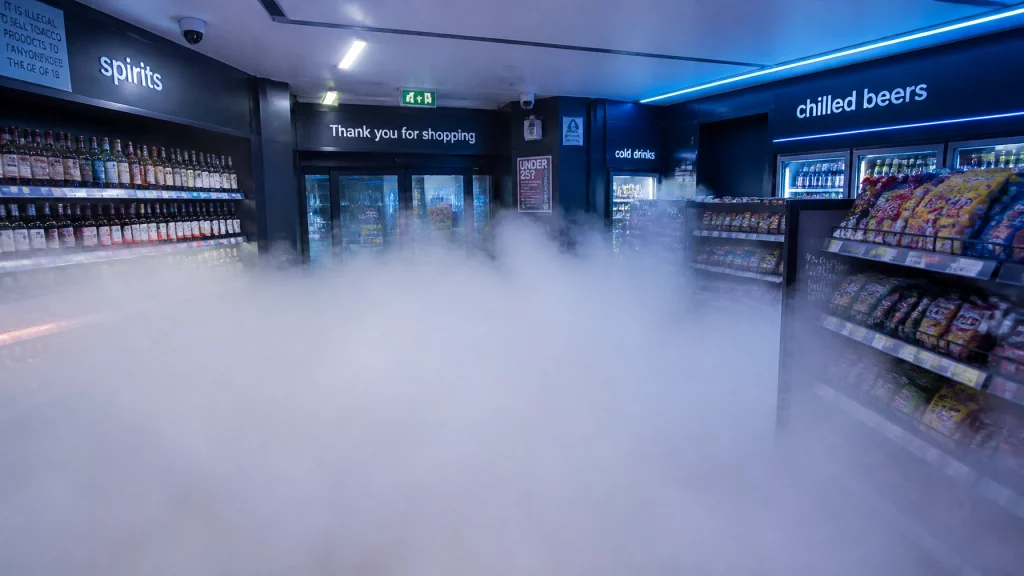
A security fog system activates the moment an intruder breaches the premises. Within seconds—not minutes—the interior fills with a dense, white fog.
Visibility drops to near zero. The thief cannot find stock. They cannot read till displays or locate high-value items. Their torches become useless. The environment becomes hostile and disorienting.
Critically, fogging does this instantly. There is no wait for police response. There is no interval during which an offender can strip shelves. The breach is met with immediate, mechanical deterrence.
The thief faces a choice: stay in the fog and operate blind, or exit immediately. Almost all choose to leave. Studies and real-world deployments confirm that a shop with a fogging system is abandoned within moments of activation.
Integration With Existing Alarms
Fogging systems do not replace your alarm. They work alongside it.
The fog is triggered by your existing alarm panel—the same sensors, the same logic, the same integration protocols. Whether you run Ajax, traditional hard-wired systems, or network-based monitoring, a fog generator activates in response to your alarm conditions. The two systems become one layered defence.
Your loss-prevention strategy now operates in two phases. First, the fog physically stops the intruder. Second, the alarm notifies your monitoring centre and police. Together, they eliminate both the initial breach window and the response window.
Sizing for Your Premises
Coverage is determined by the volume of your premises, measured in cubic metres. A small convenience store with 200 m³ of space requires a different generator than a supermarket with 3,000 m³.
Generators like the Density 900 system cover up to 900 m³ and are suitable for mid-range retail. Larger premises use the HP range—the HP6000 extends to 6,000 m³, whilst the HP14000 reaches 14,000 m³ for warehouses and large-format retail.
Sizing is critical. Undersized coverage leaves blind spots; oversized systems waste deployment cost. A site survey by a loss-prevention specialist ensures your system matches the actual usable volume of your space.
Residue and Operational Concerns
A common worry: does fog damage stock or leave residue that closes the shop for days?
The fog used by certified systems is non-toxic, tested to Eurofins standards and EN ISO 16000-1:2006. It poses no hazard to humans or animals. In food retail, the fog is certified to the Food Contact regulation (CE No. 1935/2004), meaning it is safe to deploy in premises where food is present or handled.
Residue is minimal. Most fog dissipates rapidly once ventilation begins. Surfaces require standard cleaning, not remediation. A morning clean and ventilation cycle, and the shop is ready for customers.
Meeting Standards and Certifications
Security fog systems meeting EN 50131-8:2019 have undergone rigorous testing for reliability, integration, and fail-safes. The standard ensures the system performs consistently under real-world conditions and integrates securely with alarm infrastructure.
Certified systems are also assessed for EMC (electromagnetic compatibility) and FCC compliance, confirming they do not interfere with other equipment and remain stable in noisy electrical environments common to retail.
Loss-prevention professionals and insurers increasingly recognise fogging as a credible element of a comprehensive strategy. It addresses a clear, documented gap in alarm-only deployments.
Building Your Closed-Time Defence
A layered loss-prevention strategy combines deterrence, detection, and response. CCTV deters and records. Shutters and locks delay entry. Alarms detect intrusion. Fogging eliminates the response window entirely.
Each layer serves a purpose. Together, they shift the calculus for an intending thief. The premises becomes too risky, too difficult, too slow to exploit.
Closed-time break-ins remain a reality of retail. But the response gap—the interval between breach and police arrival—is no longer inevitable. A fogging system fills that gap with immediate, tangible protection.
Frequently asked questions
Does the fog activate automatically or does staff need to trigger it?
Fogging systems activate automatically via your alarm panel when an intrusion is detected. There is no manual trigger required and no delay. The system responds instantly to the breach condition.
Can customers be inside the shop if the alarm triggers?
Most retail fogging systems are integrated into intruder detection zones that are armed only when the premises are closed and all staff have exited. Daytime operation presents no activation risk. If a zone is armed during occupied hours, staff would disarm the system as part of opening procedures.
What if the system activates by mistake?
Modern systems include diagnostics and false-alarm prevention protocols. However, any unwanted activation requires standard cleaning. Most fog clears rapidly with ventilation. This is why professional installation and staff training are essential to minimise false alarms in the first place.
Is fogging compatible with my existing alarm and VMS?
Yes. Fogging systems are compatible with all existing alarm panels and can integrate with video management systems via LAN or API. Installation is typically straightforward—the fog generator connects to your alarm relay outputs.
How often does the fog fluid need replacing?
Fluid is consumed only when the system activates. In a system that has never activated, the fluid remains viable for years. Fluid shelf-life and refill cycles depend on your usage and the generator model. Your installer will advise on maintenance intervals.
Closed-time break-ins are a known risk. Slow police response is a documented reality. But your premises does not have to remain vulnerable during those hours. A professionally installed fogging system, integrated with your alarm, creates an active defence that alarms alone cannot provide. Speak to a loss-prevention specialist today to discuss your site and arrange a survey.